


.png)
.png)

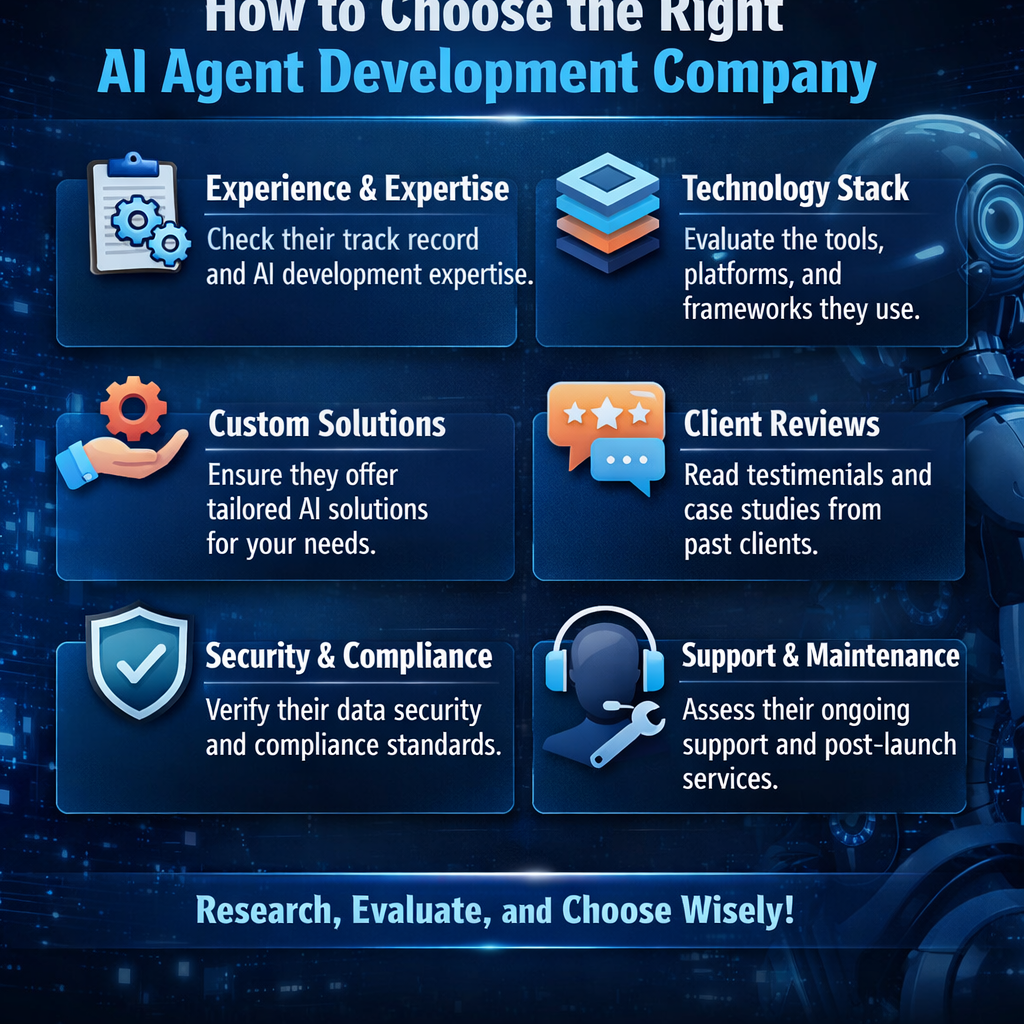

There are a lot of companies offering AI agent development right now.
And on the surface, many of them sound similar.
They talk about:
- automation
- AI-powered workflows
- intelligent systems
- custom solutions
But once you go deeper, the differences become clear very quickly.
Because building AI agents that work in production is not the same as building demos.
And the gap between the two is where most decisions go wrong.
The Reality: Most Vendors Can Build a Demo
Almost any team today can:
- connect an LLM
- write a prompt
- create a basic interface
And produce something that looks impressive.
The problem is:
That’s not what businesses need.
What you actually need is a system that:
- works with real data
- integrates with your tools
- handles edge cases
- produces consistent outcomes
And that requires a different level of thinking.
What You Should Actually Be Evaluating
Choosing the right AI agent development company is less about tools.
And more about how they think.
1. Do They Think in Workflows or Just Prompts?
This is one of the biggest differentiators.
Ask them:
- How do you design an AI agent?
- What does your process look like before building?
If the focus is on:
- prompts
- models
- tools
That’s a red flag.
Strong teams will talk about:
- workflows
- decision points
- system design
- inputs and outputs
- failure handling
Because that’s what production systems require.
2. Do They Have Real Production Experience?
There’s a big difference between:
- building prototypes
- and supporting systems in production
Ask:
- Have you deployed agents in real business workflows?
- What kind of use cases have you worked on?
- What challenges did you face post-launch?
Look for answers that include:
- integration challenges
- messy data
- edge cases
- iteration over time
If everything sounds smooth, they probably haven’t gone deep enough.
3. Do They Focus on Use Cases or General Solutions?
Be cautious of companies that say:
- “We can build an AI agent for anything”
- “We’ll automate your entire business”
Strong teams will push you to:
- narrow down the use case
- define the workflow
- focus on one outcome
Because that’s what actually works.
4. How Do They Handle Integrations?
This is where most complexity lies.
Ask:
- Which systems can you integrate with?
- How do you handle CRM integrations (like HubSpot)?
- How do you manage API failures or data inconsistencies?
If integrations are treated as a “later step,” that’s a concern.
In real implementations:
integration is core to the design.
5. Do They Address Data Quality Early?
AI agents depend on context.
And context depends on data.
A good partner will ask:
- where your data lives
- how consistent it is
- how it’s used across teams
If data is ignored early, problems show up later in production.
6. Do They Design for Failure?
Every AI agent will:
- make mistakes
- misinterpret inputs
- encounter edge cases
The question is not if.
It’s how the system handles it.
Ask:
- What happens when the agent is not confident?
- How do you handle incorrect outputs?
- Is there a fallback or escalation mechanism?
If there’s no clear answer, the system will be fragile.
7. What Is Their Approach to Iteration?
AI systems are not static.
They need:
- monitoring
- feedback loops
- continuous improvement
Ask:
- How do you track performance?
- How do you improve the system over time?
- What happens after deployment?
If the engagement ends at launch, that’s a risk.
Red Flags to Watch For
Some patterns show up frequently in weak implementations.
Overemphasis on Tools
Talking more about:
- frameworks
- models
- platforms
…than actual workflows and outcomes.
Vague Use Case Definitions
Not pushing for clarity around:
- what the agent should do
- how success is measured
Demo-Heavy Approach
Showing:
- impressive outputs
- conversational abilities
…but not explaining:
- system behavior in production
- integration details
- failure handling
No Mention of Edge Cases
If everything sounds straightforward, it usually means:
real-world complexity hasn’t been considered.
No Post-Launch Plan
AI agents without iteration:
- degrade over time
- become less relevant
- lose trust quickly
What a Strong AI Agent Partner Looks Like
From what we’ve seen, the right development partner usually:
- pushes you to define a clear use case
- maps workflows before building
- integrates early with real systems
- designs for edge cases and failure
- focuses on outputs and actions, not just responses
- includes monitoring and iteration
They don’t just build.
They design systems.
Questions You Should Ask Before Deciding
A few direct questions can reveal a lot:
- What is your process for designing an AI agent?
- How do you handle real-world data issues?
- What integrations have you worked with?
- How do you manage failure scenarios?
- What does your post-launch support look like?
- Can you walk me through a real production use case?
The answers will usually make the decision clearer.
The Bigger Insight
-
Choosing an AI agent development company is not about:
- who has the best tools
- or who uses the latest models
It’s about:
- who understands systems
- who has worked with real workflows
- who knows where things break
- and how to fix them
The Reality of AI Agent Development
-
AI agents are not plug-and-play solutions.
They require:
- structured thinking
- integration with systems
- handling of imperfect data
- continuous improvement
The right partner helps you navigate that.
The wrong one leaves you with a demo that doesn’t scale.
If You’re Evaluating Vendors
Focus less on:
- how impressive the demo is
Focus more on:
- how the system will behave in production
Because that’s where the real value is created.
FAQs
What should I look for in an AI agent development company?
Look for experience with real workflows, strong system design thinking, integration capabilities, and a clear approach to iteration and improvement.
Are demos a good way to evaluate AI vendors?
Demos are useful, but they don’t reflect real-world performance. Focus on how the system handles real data, integrations, and edge cases.
How important is integration in AI agent development?
Very important. Without integration into systems like CRMs and APIs, agents rarely deliver meaningful business value.
Do AI agent projects require ongoing support?
Yes. Monitoring, feedback, and iteration are essential for maintaining performance and relevance.
Can one company build AI agents for all use cases?
In theory, yes. In practice, focused use cases and domain understanding lead to better outcomes.
What is the biggest mistake when choosing a vendor?
Choosing based on tools or demos instead of evaluating their approach to workflows, system design, and real-world execution.
You might also like
.png)
March 16, 2026
7 Ways to Use HubSpot Forms to Capture More Qualified Leads
Introduction You may already be using forms on your website — to collect email addresses, contact requests, or demo sign-ups.

August 18, 2025
What Is HubSpot CMS Hub? A Beginner’s Guide 2025
Introduction If you're a growing business looking to scale your digital presence, improve your lead generation, and reduce dependence on developers, then HubSpot CMS Hub is a platform you should definitely consider.

September 13, 2022
Taking a small business owners Whatsapp group to an Online Platform
Technology and Digital platforms can have a huge how small business and communities scale & transform. At The Web Plant, we have always encouraged our customers, partners and communities to use digital platforms to scale by reducing redundancies in...
Receive the latest updates.
Power Up Your Project
Request a Quote and Let Us Save the Day!

Leave a reply